

Custom tin box packaging is no longer just a “nice to have” detail. For global OEM brands in food, beauty, gift, and industrial sectors, a well-engineered custom metal tin box has become a strategic tool for product protection, brand storytelling, and supply-chain efficiency.
As an OEM buyer or project manager, you are not simply ordering a decorative container — you are managing a full packaging project: structure design, food-contact compliance, artwork, testing, and on-time delivery across multiple markets. This article will walk you through how Custom Tin Box solutions work for global OEM projects, what technical details you should care about, and how a professional factory like Mr. Tin Box supports you from concept to mass production.
Table of Contents
1. What Is a Custom Tin Box for OEM Projects?

1.1 Definition and Typical Applications
A custom tin box is a metal packaging solution made from tinplate or other steel alloys, designed and produced according to the unique specifications of a brand or OEM project. Instead of using standard off-the-shelf cans, you specify dimensions, structure, printing, finishing, and inserts to match your product and brand identity.
In global OEM business, custom metal tin boxes are widely used for food (tea, coffee, biscuits, chocolate), beauty and personal care sets, premium spirits, seasonal gift packs, collectibles, and industrial components. For high-value or sensitive products, this type of packaging combines mechanical protection, barrier performance, and a premium unboxing experience.
1.2 Why OEM Projects Choose Custom Metal Tin Packaging
OEM projects often target several markets, each with different regulations and consumer expectations. A custom metal tin box lets you harmonize branding while fine-tuning structural details or labels for each region.
Compared with generic packaging, custom tins can improve product shelf presence, support special promotions, and reduce damage during transportation. When properly engineered, they can also reduce secondary packaging, optimize pallet loading, and lower total landed cost per unit.
1.3 Common Structures and Opening Styles
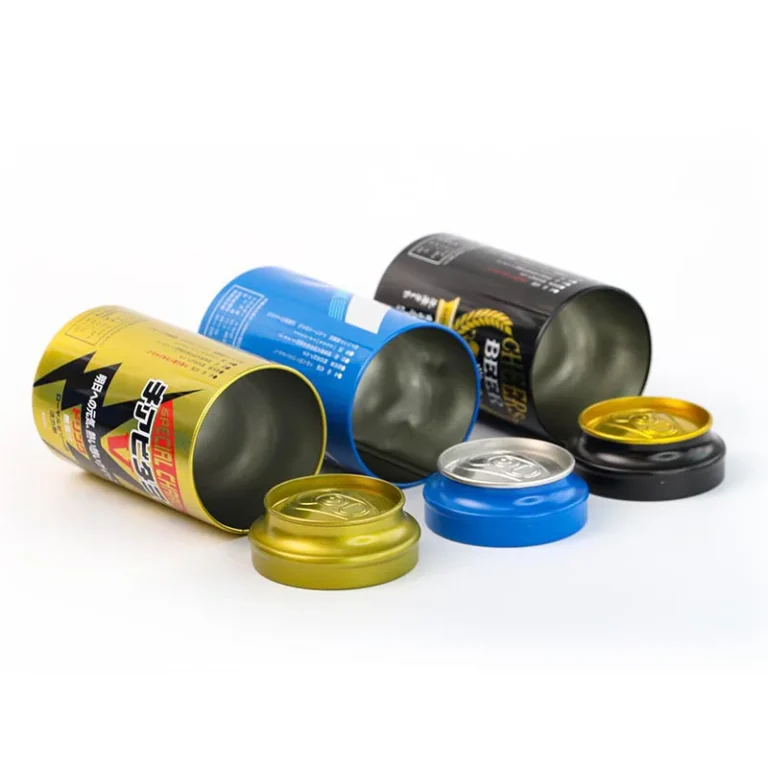
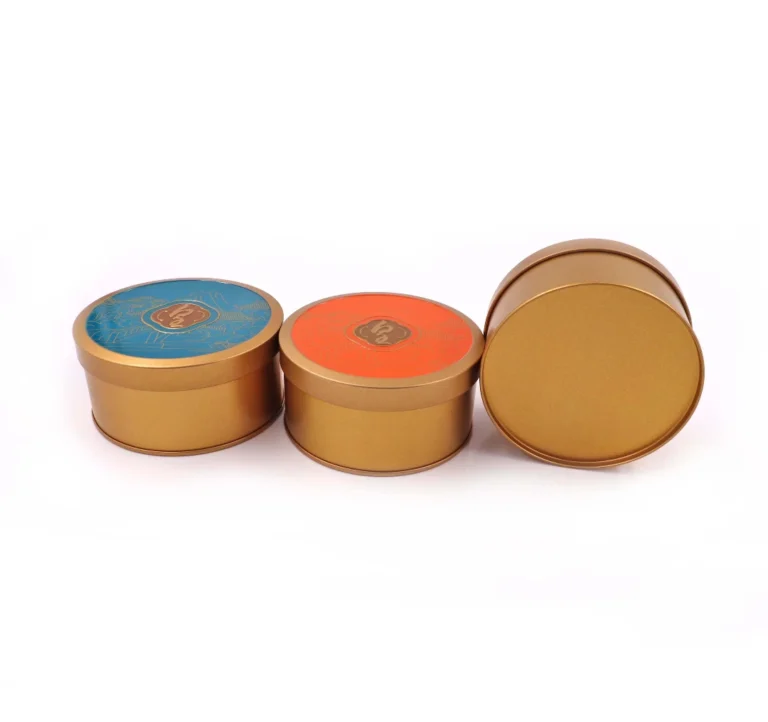
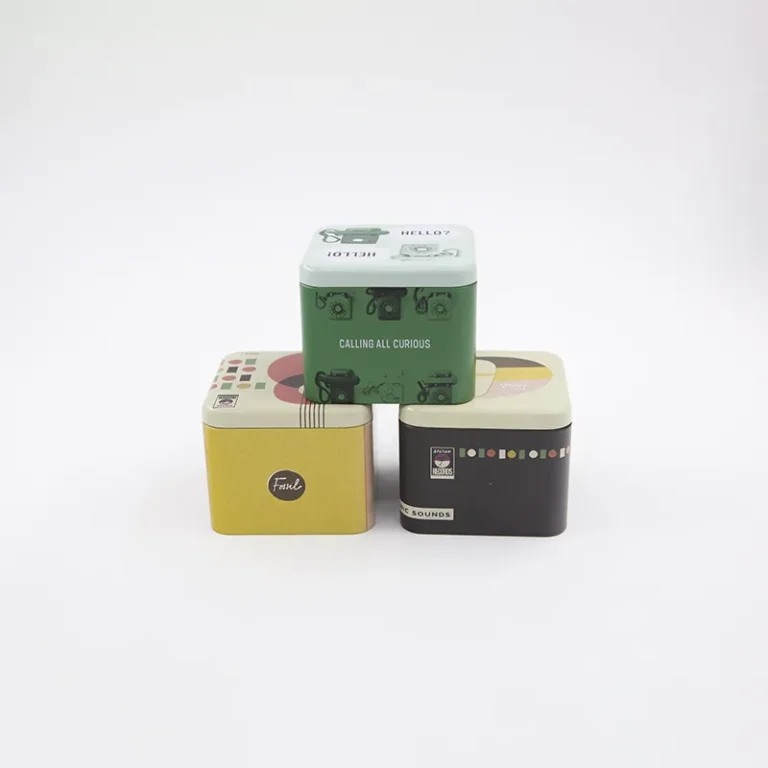
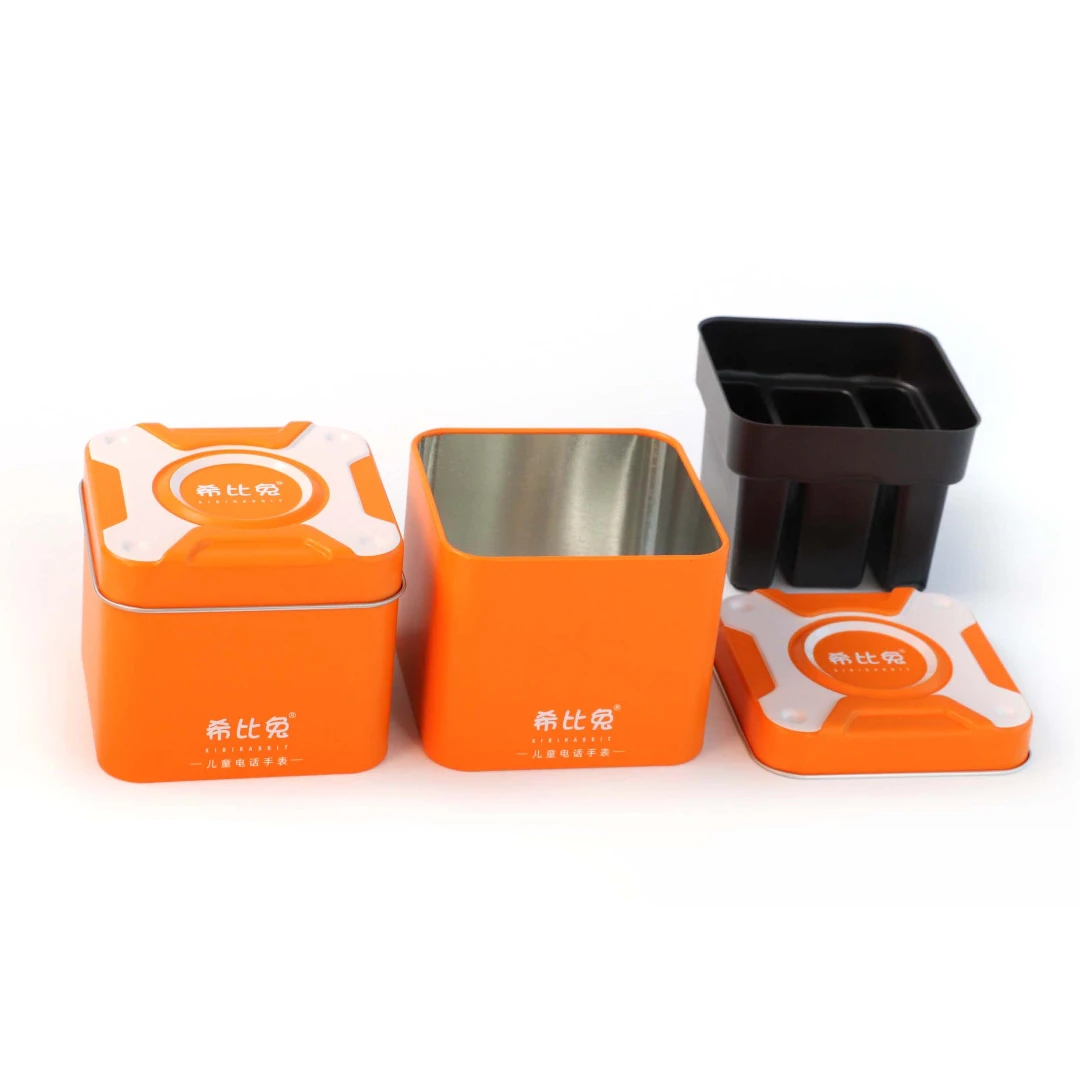
Custom tin boxes come in many forms: round, square, rectangular, book-shaped, heart-shaped, and complex irregular shapes. The structure can be a slip lid, hinged lid, window lid with PET/PC window, telescopic body, or multi-layer gift box set with removable trays.
For OEMs, structure choice is usually driven by product size, stacking stability, and branding. For example, a rectangular hinged lid tin is ideal for biscuits or gift sets because it opens like a book and presents the product nicely, while a tall round tin is perfect for tea or coffee with a vertical shelf presence.
2. Key Design Parameters for Custom Metal Tin Box Solutions
2.1 Size, Shape and Volume Optimization
One of the first decisions in any Custom Tin Box project is deciding the box size, shape, and internal volume. These parameters must match:
- Product dimensions (primary packaging or loose product)
- Filling process and automation (hand-filling vs automatic line)
- Carton and pallet layout for shipping and warehousing
In early stages, our engineering team usually proposes 2–3 size options with 3D drawings and internal volume estimations. This allows OEM buyers to compare material usage, freight efficiency, and shelf display. Small adjustments of 2–3 mm in height or width can sometimes significantly improve carton utilization and reduce shipping cost.
2.2 Material Selection: Tinplate Grade, Thickness and Coatings
Most custom metal tins are made from tinplate (electrolytic tin-coated steel) or tin-free steel. Material selection must consider:
- Required strength and stacking load
- Corrosion resistance
- Food-contact safety
- Print quality and surface smoothness
For food contact applications in the EU, metal packaging must comply with Regulation (EC) No 1935/2004 on materials and articles intended to come into contact with food. You can find an overview on the European Commission’s official page for food contact materials and its legislation framework, which defines general safety and inertness requirements for all food contact materials, including metals (European Commission – Food Contact Materials). Food Safety
Technical guidelines specifically for metals and alloys used in food contact materials are also published by the European Directorate for the Quality of Medicines & HealthCare (EDQM), which provide reference limits and safety considerations for various alloys (EDQM – Metals and Alloys Used in Food Contact Materials). edqm.eu
As a global OEM buyer, you don’t need to memorize all these standards — but you do need a supplier who understands them and can recommend suitable tinplate coatings, internal lacquers, and protective varnishes based on your product type (dry food, high-fat food, acidic snacks, cosmetic formulations, etc.).
2.3 Printing, Branding and Surface Finishing
The outer surface of a custom metal tin box is your mini billboard. Lithographic printing allows CMYK or spot colors with very fine detail, gradient backgrounds, and photographic images. For premium projects, we often combine:
- Gloss, matte, or satin varnish
- Embossing or debossing on logos, brand names, or patterns
- Spot UV, metallic inks, crackle effects, or soft-touch varnish
- Gold, silver, or holographic foil details
A well-designed custom metal tin box can remain on the customer’s desk or shelf long after the product is consumed, extending brand exposure for months or even years.
2.4 Structural Features: Hinges, Windows and Inserts
Structural details make a big difference in the user experience. Common options include:
- Hinges and clasps: for premium gift tins and collectible boxes
- Clear windows: usually PET or PC, to display the product without opening
- Internal trays: made of tin, plastic, cardboard, EVA, or foam to hold products securely
- Stacking beads and ribs: to increase strength and allow safe stacking in warehouses
When we design OEM projects, these features are integrated into the 3D structure from the start, ensuring tooling feasibility and stable mass production.
3. Compliance, Food Contact Safety and Testing
3.1 Overview of Global Food Contact Regulations
If your custom tin box will be used for food or cosmetics, compliance is not optional; it is mandatory. In the EU, all food contact materials must comply with Regulation (EC) No 1935/2004 and Good Manufacturing Practice rules, while the European Food Safety Authority (EFSA) provides scientific opinions on safety (EFSA – Food Contact Materials). European Food Safety Authority
In addition, technical guides on metals and alloys specify migration limits and testing methods to ensure that metals used in packaging do not release harmful substances into food (Metals and Alloys Technical Guide – EDQM). edqm.eu
Outside Europe, other markets (such as the US, Japan, and China) have their own regulatory frameworks for food-contact metals and coatings. A professional OEM packaging partner should be familiar with these regulations and help you choose globally acceptable materials, or design project-specific solutions for each target market.
3.2 Third-Party Testing and Certification
Laboratory testing is often required to verify migration limits, heavy metal content, coating performance, and overall safety. Global testing organizations such as SGS offer packaging testing and specific food contact material (FCM) testing services to check compliance with EU, US, and other regional regulations (SGS – Packaging Services & Food Contact Regulations). SGSCorp
For large OEM projects, our factory can coordinate with third-party labs on your behalf, arranging testing on lacquered tinplate, completed tins, or product-filled samples. Test reports and Declarations of Compliance (DoC) can then be used as part of your internal quality system and to support retailer audits.
3.3 Quality Management Systems (ISO 9001 and Beyond)
Beyond legal compliance, OEM buyers also care about supplier quality systems. The ISO 9001 standard defines the requirements for a quality management system and is widely used as a benchmark for consistent product quality and process control (ISO – ISO 9001 Quality Management Systems). ISO
Working with an ISO 9001-certified metal packaging factory means that your custom tin box projects follow structured procedures for design review, sample approval, production, inspection, and corrective actions. For food and cosmetics, this may also be combined with HACCP or other hygiene management systems to improve overall risk control.
4. Typical OEM Project Workflow with Mr. Tin Box

4.1 Step 1 – Concept, Requirements and Feasibility
Every Custom Tin Box OEM project starts with a clear brief. At this stage, we collect:
- Product type and target markets
- Desired size, structure, and capacity
- Brand guidelines and reference designs
- Annual volume, launch date, and budget range
Our engineering and sales team then evaluates feasibility, suggesting material specs, lid structure, and finishing options that fit your project goals. Early involvement at this stage helps avoid costly changes later.
4.2 Step 2 – 3D Drawings, Prototypes and Artwork
Once basic direction is confirmed, we create detailed 3D drawings with all critical dimensions, tolerances, and structural features. In most OEM projects, we prepare white samples (unprinted tins) or digital mock-ups so that your team can review ergonomics, opening feel, and product fit.
At the same time, your designers prepare artwork based on our official die-line. We support color management, Pantone color matching, and print proofing to ensure that brand colors are reproduced accurately on metal surfaces.
4.3 Step 3 – Tooling, Trial Run and Mass Production
After sample approval, we move to tooling and pilot production. Custom mold sets are built for punching, forming, and curling processes. A trial run verifies forming consistency, printing alignment, and assembly quality before full mass production.
During mass production, our QC team follows documented inspection procedures at each stage: incoming material, printing, punching, forming, assembly, and final packing. For OEM clients, we can share inspection reports, photos, and on-line QC data to maintain transparency.
4.4 Step 4 – Packaging, Logistics and Global Delivery
The last step of a global OEM custom metal tin box project is safe and efficient delivery. We design export cartons and palletization schemes to balance protection and shipping cost. Edge protectors, corner boards, and stretch wrapping are used for long-distance sea freight.
For multi-country projects, we can ship to different destinations, coordinate with your forwarders, or provide DDP/DDU solutions depending on your needs. Stable packaging design and clear labeling reduce the risk of damage, mis-delivery, and customs delays.
5. Cost Drivers and Optimization in Custom Tin Box OEM Projects
5.1 Main Cost Components
Understanding cost structure helps you negotiate more effectively and make rational decisions. The main cost drivers in a Custom Tin Box project include:
- Tinplate material type and thickness
- Internal and external coatings and lacquers
- Printing complexity (number of colors, special effects, embossing)
- Tooling and mold investment
- Project MOQ (minimum order quantity)
- Assembly complexity (hinges, windows, inserts)
- Packing style and logistics route
A small change in structure can significantly affect tooling complexity and unit cost. For example, adding an embossed logo might require additional tooling, but it can also enhance perceived value enough to justify a slightly higher cost.
5.2 Balancing Budget and Premium Look
Many global OEM brands want a premium look at a mid-range cost. This is where smart engineering and finishing selection make a difference. Instead of using thick tinplate and multiple embossing steps, we can often achieve a similar high-end effect by combining:
- A matte varnish background with spot gloss on key elements
- Single-level embossing for the logo only
- Well-designed graphics that simulate depth and texture
By prioritizing the elements that matter most to the consumer — logo prominence, color accuracy, and tactile feel — we keep your custom metal tin box visually premium while staying within budget.
5.3 Total Landed Cost and Supply Chain Efficiency
For global OEM projects, unit price is only one part of the equation. You also need to consider:
- Carton and pallet efficiency (how many tins per container)
- Damage rate during transport
- Warehousing space and handling cost
- Customs duties and local taxes
A slightly smaller box or improved stacking design can increase container loading by a few percentage points, which often offsets minor material cost differences. Our project team helps you evaluate these trade-offs so you can choose the most cost-effective solution from a total landed cost perspective.
6. Use Cases: How Global Brands Use Custom Metal Tin Boxes
6.1 Food & Beverage: Tea, Coffee, Biscuits and Confectionery
In food and beverage, Custom Tin Box packaging is widely used for tea leaves, coffee beans, biscuits, cookies, and chocolate assortments. Metal packaging provides excellent barrier protection against light, oxygen, and moisture, helping to preserve flavor and shelf life when used together with internal bags or sealed liners.
For premium tea or coffee, a tall round or square tin with airtight lid and inner seal becomes part of the product itself — customers often reuse the container at home, extending brand visibility. Seasonal biscuit tins with festive artwork are popular in retail and can be adapted annually with new designs while keeping the same basic structure.
6.2 Beauty, Personal Care and Wellness
Custom metal tins also work well for balm, soap, solid perfume, and skincare gift sets. A custom metal tin box signals quality and durability, differentiating your brand from standard cardboard or plastic packaging.
For beauty OEM projects, we often design compact, travel-friendly tins, as well as larger gift boxes with removable inserts for bottles and jars. Internal coatings and compatibility testing are especially important if the product may leak or interact with metal; in such cases, we recommend secondary containers plus a tested internal lacquer system.
6.3 Gift Sets, Promotions and Licensed IP
Many global brands use custom tins for limited-edition gift sets, co-branded campaigns, and licensed character collections. Metal tins add perceived value and collectability, which is ideal for seasonal promotions, movie tie-ins, or anniversary editions.
Because OEM timelines for these projects can be tight, we pay extra attention to schedule planning — aligning artwork deadlines, sampling, production, and shipping with your campaign launch date. Efficient project management ensures your Custom Tin Box arrives in time for the campaign window.
6.4 Industrial and Specialty Applications
Beyond consumer goods, custom tin boxes are used for tools, fasteners, electronic components, and specialty industrial products. Here, the focus is often on protection, clear labeling, and repeatable stacking.
We can design robust tins with reinforced corners, inside partitions, and anti-corrosion coatings suitable for long-term storage or harsh environments. For some industrial OEM customers, metal tins also provide an added level of security and tamper evidence compared with flexible packaging.
7. How to Brief Your Supplier for a Successful Custom Tin Box OEM Project

7.1 Technical Specification Checklist
A clear and complete technical brief saves time and avoids repeated modifications. When you contact a supplier like Mr. Tin Box, try to provide:
- Target outer dimensions and product fit information
- Preferred structure (slip lid, hinge, window, etc.)
- Material and thickness expectations (if known)
- Food contact status and target markets
- Annual and first order quantities (MOQ and forecast)
Even if you don’t have all the answers, this checklist gives us a starting point to advise you on feasible custom metal tin box solutions.
7.2 Artwork, Color Management and Branding Assets
Artwork quality has a huge impact on the final result. We recommend providing:
- Editable vector files (AI, PDF, or EPS)
- Pantone references or color swatches
- Clear guidelines for logo size and safe zones
- Any necessary legal or regulatory texts (ingredients, barcodes, recycling symbols)
Before mass production, we can provide digital proofs or print samples so your brand and marketing teams can validate color and layout accuracy on metal.
7.3 Timeline, Testing and Documentation
Finally, align expectations on timeline and documentation from the beginning. Typical OEM timelines include phases for design, sampling, testing, tooling, and mass production. If third-party testing or retailer audits are required, build extra time into the schedule.
We can help you prepare testing plans, coordinate with labs, and generate documentation such as Declarations of Compliance, material specification sheets, and quality inspection reports — all of which support smooth project execution and market entry.
8. Why Work with Mr. Tin Box for Global OEM Custom Metal Tin Box Solutions
8.1 Deep Experience in Metal Packaging for International Brands
Mr. Tin Box specializes in custom tin box design and manufacturing for global OEM clients. Our team has experience in food, confectionery, tea and coffee, beauty, gift, and industrial projects across Europe, North America, and Asia-Pacific.
Because we focus on custom metal packaging every day, we understand the technical details that matter: sheet layout optimization, curling radius, embossing depth, stacking strength, and print registration — details that can make or break large-volume OEM projects.
8.2 Engineering Support from Concept to Mass Production
We provide full engineering support, including structure design, 3D modeling, prototyping, and tooling optimization. Our goal is not only to make a beautiful custom metal tin box, but also to ensure that it can be produced efficiently and consistently at scale.
For complex structures, we simulate forming and assembly steps, evaluate potential risk points, and propose improvements before tools are cut. This reduces trial-and-error and keeps your project on schedule.
8.3 One-Stop OEM Service and Long-Term Partnership
From material sourcing and printing to forming, assembly, packing, and logistics, Mr. Tin Box offers a one-stop solution. We coordinate with third-party labs for food-contact testing, support ISO-based quality management, and can adapt packaging designs for different retailers or regional requirements.
Rather than treating each order as a one-off transaction, we aim to build long-term partnerships. By understanding your product roadmap and brand strategy, we can proactively propose new Custom Tin Box concepts, cost-saving options, or premium limited-edition designs to support your future launches.
Ready to Develop Your Next Custom Metal Tin Box OEM Project?
Whether you are planning a new global biscuit gift line, a premium tea collection, a limited-edition cosmetic set, or a robust industrial kit, a well-designed custom metal tin box can elevate your product and simplify your supply chain.
Share your project idea, drawings, or even a simple sketch with Mr. Tin Box, and our team will help you turn that concept into a reliable, compliant, and commercially successful OEM packaging solution — from the first sample to millions of pieces shipped worldwide.
FAQ
What is a Custom Tin Box?
A custom tin box is a special metal container made for specific products and brands. Unlike regular tins you find in stores, these boxes can be made in different shapes, sizes, and designs to meet your needs. They are commonly used for items like food, beauty products, and gifts, providing strong protection and a unique look that attracts customers.
Why should I choose a Custom Tin Box for my product?
Using a custom tin box helps your product stand out on the shelves. It can be made to match your brand colors and style, which tells customers about your product even before they open it. Custom tins also protect your items during shipping and help keep them fresh, especially for food and cosmetics.
What types of products use Custom Tin Boxes?
Custom tin boxes are used for many products including tea, coffee, cookies, chocolates, and beauty items. They are great for gifts and can be designed for special seasons or events. Brands choose custom tins because they add a touch of elegance and quality that makes products more appealing.
How are Custom Tin Boxes made?
The process usually starts with a design. Then, a factory makes models to show how the boxes will look. They select materials that are safe for food or cosmetics. After that, they produce the tins, which includes printing designs and assembling them. Finally, the boxes are checked for quality before shipping.
What are the benefits of using Custom Tin Boxes instead of regular packaging?
Custom tin boxes provide better protection for your products and are more attractive to customers. They can be reused, which makes them environmentally friendly. Also, because they are made specifically for your product, they can save space during shipping, making the whole process more efficient.
Are Custom Tin Boxes safe for food?
Yes, custom tin boxes can be made safe for food use. They need to meet specific regulations to ensure that no harmful substances can get into the food. When working with a good supplier, you can ensure that the materials used are compliant with safety standards.
How do I communicate my needs for a Custom Tin Box to a supplier?
When talking to a supplier, be clear about your product’s size, shape, and how much you want to produce. Share your ideas about how you wish the box to look, including colors and any designs. Providing examples will help them understand your vision better.
What is the typical timeline for creating a Custom Tin Box?
Creating a custom tin box can take a few weeks to several months, depending on its complexity. The timeline includes steps for design, creating samples, getting approvals, and mass production. It’s important to plan in advance, especially if you have a launch date.
Can I track my Custom Tin Box order?
Yes, reputable suppliers will keep you updated on your order status. They can provide shipping details so you can track when your boxes are made and when they are shipped to you.
How does using Custom Tin Boxes help with branding?
Custom tin boxes serve as a visual marketing tool. Their unique designs can create a strong impression and keep your brand in customers’ minds. When they see your tin box in their home or office, it reminds them of your brand and increases the chances of future sales.